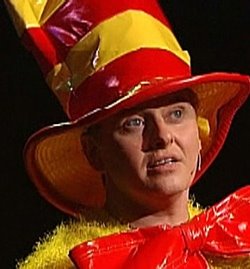
Watch on Youtube ~ Dr. Seuss Bible ~ by The Kids In The Hall
The New Testament according to Dr. Seuss
And now for the Dr. Seuss Bible:
One day God said, "This is what I will do:
I'll send down my son. I'll send him to you
To clear up this humpity bumpity hullaballoo.
His name will be Christ and he'll never wear shoes.
His pals will all call him 'The King of the Jews.'"
He didn't come in a plane.
He didn't come in a Jeep.
He didn't come in a pouch
Of a high jumping Voveep.
He rode on the back of a black Sassatoo
Which is the blackiest creature you ever could view.
He rode to Jerusalem -- home of the grumpity Jews
Where false prophets were worshiped -- some even in twos.
There was Murray VonMyrrh and Ghengis Vovooz --
The one you could worship by taking a snooze.
Christ spoke from a mound
Which is a pile of ground.
People gathered around
Without making a sound.
Thus he spake:
"Sin in socks
Socks full of sin.
How do we quiet
This Jehovaty din?
Do unto others as they do unto you.
That includes you, young Timothy Foo."
One pharisee said to another he knew,
"What shall we do with this uppity Jew?"
"Let's wash him in wine and make him all clean
And into Sam Zittle's crucifiction machine."
Twirl the Gawhirl
And release the Galeese
And in go the nails
As fast as you please.
And it is said
That he said as he bled,"Forgive them Father,
for they know not what they do.
For they walk throughout life in toe crampity shoes."
Do you?
Amen.
Other Links:
For somebody who doesn't believe in God you really talk about him a lot! It strikes me that someone who accuses “religious people” of intolerance you really seem as intolerant of them. Which almost makes your intolerance a “religion”. Like a Crusade.
ReplyDeleteRE anonymous:
ReplyDeleteI think religions are cultural memes.
MEME: n : a cultural unit (an idea or value or pattern of behavior) that is passed from one generation to another by nongenetic means (as by imitation); "memes are the cultural counterpart of genes"
The religious memes in many nations are now evolving rapidly into political memes.
As a result of this piggybacking of memes, I find it difficult to trust the political judgement of people who believe in religious invisible beings.
People who believe in invisible beings also tend to believe in invisible weapons of mass destruction.
People who believe in invisible beings also tend to believe that it is great to blow yourself up and others, in the service of an invisible being.
The judgement of believers concerning important political issues is more than dubious.
Their belief requires them to imagine the improbable and then demand that it is true.
RE anonymous:
ReplyDeleteI am tolerant of everyone's right to believe whatever they want, but I do not have to tolerate the belief.
The belief they have might involve sadistic behaviour enacted upon women.
FOR EXAMPLE: If you had a belief that all women should have their clitorises removed, should I allow you to have that belief?
Or should I question that belief?
Should I allow you to have that belief, but ask for reasoned discourse concerning why everyone should have that belief?
Beliefs lead to actions.
There are many beliefs, not just religious ones, and I think it is morally responsible to question beliefs which may be harmful.
I almost agree with you. . . . as I do with Harris & Dawkins. The problem I have fronted, is that beliefs and persons are too close one to the other that is difficult not to critic one without critic the other. And then becomes the offense.
ReplyDeleteMaybe there is a -way- to expose it without falling into this trouble. Is a matter of the way of saying things.
Anyway, I have founded that the blogs are those kind of media where you can talk of everything in a good way, as yours.
Which almost makes your intolerance a “religion”.
ReplyDeleteThat makes no sense whatsoever.
Like a Crusade.
That makes even less sense.
People who believe in invisible beings
ReplyDeletePeople who believe in invisible things are also capable of doing a lot of good. It's just that there is no necessary connection betweeen "belief in invisible things" and "doing good" or "doing ill."
As for myself, I don't believe in God for the same reason I don't believe in Santa or the Tooth Fairy. No evidence for their existence; no reason to believe that they exist.
RE arthur:
ReplyDelete"People who believe in invisible things are also capable of doing a lot of good. It's just that there is no necessary connection betweeen "belief in invisible things" and "doing good" or "doing ill."
I wasn't trying to make a connection that people who believe in invisible beings do good or bad.
But I think because they are prepared to believe quite extraordinary things, that they are more suscpetible to persuasion to believe in other quite extraordinary and unrealistic things.
So, I do doubt their ability to understand the difference between fact and fiction.
Are they discerning examiners of information?
I think they are selective, according to that which fits their pre-existing belief systems.
So perhaps they have a pre-existing condition which allows them to believe all sorts of wank.
RE:beepbeepitsme
ReplyDeleteI agree. We should question beliefs which may be harmful.
RE:arthur
It's just that there is no necessary connection betweeen "belief in invisible things" and "doing good" or "doing ill."
That makes no sense whatsoever.
RE: beepbeepitsme
ReplyDelete"I think religions are cultural memes."
Religion/s in the traditional sense of the word - yes. Religion might be the most dangerous thing that has happened to the human race. I've seen peoples lives destroyed because of it. I've seen people killed for it. I’ve seen marriages fail due to religious fanaticism.
But I’ve seen and experienced the other side of the coin as well. I’ve seen someone with no religious background experience (there is a difference between invisible and experience – you have never “seen” the wind but you might have experienced the effects of the wind. You’ve never seen your brain either – but you believe in it) something mystical. An awakening that prompts them to have faith in something they’ve never seen before. Something that changes their lives and cause them to change their behaviour. It’s got nothing to do with political agendas, intolerance of others etc. (That by the way is religion).
Anonymous:
ReplyDeleteI've read quite a bit here and have to say that I haven't really found much intolerance. I think you may be confusing intolerance with the simple idea that we should tell it as it is.
Really, it is quite simple. There is no evidence to suggest that God actually exists. Should you provide testable and incontrovertible evidence to the contrary, then I'm sure that Beepbeep (and many others) would analyse the evidence provided and come to a different conclusion. One based on the evidence, no doubt.
Oh, the other thing I've seen a lot of here is Beep being willing to discuss the opinions posted here. I don't think we can put that under "intolerant" either.
Enjoyed you blog Beep...:)
But I think because they are prepared to believe quite extraordinary things, that they are more suscpetible to persuasion to believe in other quite extraordinary and unrealistic things.
ReplyDeleteWell, there are many (I don't know about "most", but many) theists who aren't given to believing in extraordinary/unrealistic things, such as, say, Creationism or astrology--and who are quite prepared to admit that their belief in God is not a rational one (in the sense that they realise that they cannot demonstrate God's existence by way of appealing to evidence in the natural/material/observable Universe), and who are happy to accept that the natural Universe is governed by natural laws, and so on. For these people, God's existence is neither a matter of fact nor fiction, because "fact" and "fiction" are terms that apply to the physical Universe. (You do realise I'm playing devil's advocate here?)
So I think you might have things the wrong way around. It isn't that theism predisposes one to believe in ridiculous things such as Creationism or astrology. Those who simultaneously believe in invisible things and in ridiculous things might be afflicted by a cognitive failing that neither rational atheists nor rational theists possess.
This latter group of people certainly would have difficulty separating fact from fiction, insofar as they have similar difficulty separating the physical from the metaphysical and the natural from the supernatural. Does it suggest a genetic predisposition? I don't know. There was a time when almost nobody recognised the distinction between the natural and the supernatural--but that doesn't mean that the human race at that time was a pack of idiots! It just means that the "natural versus supernatural" or "science versus religion" memes either did not exist (certainly not in their current form) or were not widespread.
It's just that there is no necessary connection betweeen "belief in invisible things" and "doing good" or "doing ill."
ReplyDeleteThat makes no sense whatsoever.
Why not?
(there is a difference between invisible and experience – you have never “seen” the wind but you might have experienced the effects of the wind.
Intelligent Pushing :)
RE caribou
ReplyDeleteThanks for the link mate.
RE anonymous:
ReplyDelete"you have never “seen” the wind but you might have experienced the effects of the wind. You’ve never seen your brain either – but you believe in it) something mystical."
Sorry, but that is plain "woowoo language."
It is disingenous to suggest that the god meme is in any way related to the scientific evidence we have for wind and the brain.
The "invisible god meme" has no scientific evidence for it's existence.
Wind velocity and direction are demonstrable and measurable. The "invisible god" is neither demonstrable nor measurable.
I have seen pictures of my brain. I don't need to believe that brains exist. Though in the case of theists I might require evidence of said brains from now on before I allow them to post comments.
The "invisible god" is neither demonstrable nor measurable.
ReplyDeleteIndeed: by "visible" we mean "demonstrable or measurable." Our anonymous friend is taking us too literally. (But then, should that really surprise us?)