
BEEP! BEEP! IT'S ME.

"Begin at the beginning,and go on till you come to the end: then stop." (Lewis Carroll, 1832-1896)

Alice came to a fork in the road. "Which road do I take?" she asked."Where do you want to go?" responded the Cheshire cat."I don't know," Alice answered."Then," said the cat, "it doesn't matter."

"So long as I get somewhere," Alice added as an explanation. "Oh, you're sure to do that," said the Cat, "if you only walk long enough."

"All right," said the Cat; and this time it vanished quite slowly, beginning with the end of the tail, and ending with the grin, which remained some time after the rest of it had gone. "Well! I've often seen a cat without a grin," thought Alice; "but a grin without a cat! It's the most curious thing I ever saw in my life!"

My Photo
Name: Beep Beep
Location: Australia

I am diagonally parked in a parallel universe. Like Arthur Dent from "Hitchhiker's Guide To The Galaxy", if you do not have a Babel Fish in your ear this blog will be completely unintelligible to you and will read something like this: "boggle, google, snoggle, slurp, slurp, dingleberry to the power of 10". Fortunately, those who have had the Babel Fish inserted in their ear, will understood this blog perfectly. If you are familiar with this technology, you will know that the Babel Fish lives on brainwave radiation. It excretes energy in the form of exactly the correct brainwaves needed by its host to understand what was just said; or in this case, what was read. The Babel Fish, thanks to scientific research, reverses the problem defined by its namesake in the Tower of Babel, where a deity was supposedly inspired to confuse the human race by making them unable to understand each other.

"DIFFICILE EST SATURAM NON SCRIBERE"

Subscribe to BEEP! BEEP! IT'S ME

Sunday, December 31, 2006

Pavlov's Religious Conditioning


There are lots of things I don’t believe. I would suggest there are many things that most of us don’t believe. The question is: Why do people disbelieve some claims and accept others?

Belief or disbelief hinges upon what is considered evidence. But it can also affected by information with suits our emotional or psychological needs. What we think we need emotionally or psychologically may create the desire to believe concepts which, if we were not so emotionally or psychologically needy, would be dismissed as wishful thinking.

That is, the desire to believe in improbabilities might be directly correlated to our desire for emotional and psychological gratificiation. Or, we believe things because it makes us feel good. Being told that evidence suggests that the diversity of life is the result of favorable genetic traits being more likely to survive and reproduce than unfavorable traits, doesn’t produce the same level of “feel good chemicals” in the brain as being told that there is a special father-like figure who lives everywhere who has a special plan for each of us individually.

There may be in some people a chemical response preference for that which makes them feel good about themselves. That human beings can elicit a positive emotional response to a concept does not mean that the concept itself is true. What it may mean is that human beings have developed, through cultural, societal and political influences, a favourable reaction and response to certain concepts.

It may be like a favourable word association that is played in our brains. The god meme is planted through cultural and religious immersion and the favourable response to that concept is elicited emotionally and psychologically. Perhaps in a similar way that behaviour modification theorists equated the ringing of a bell with a saliva response in dogs. Now, I know that the Pavlov’s dogs theory as used will be unpopular, but popularity is also no determinant for truth.

I suggest that our brains have been trained by the cultures in which we are immersed in, to find the concept of a god as pleasurable.
Then, in order to elicit a pleasurable response in ourselves and others en masse, all that is required is the trigger. The trigger for this positive emotional response, is the word god or jesus.

If you live in a muslim country where a similar process has occurred, the trigger is allah, or muhammad. And so it applies to other words which eventually just by the thought of them, or the speaking of the word, elicit a positive or a negative emotional response.

Of course words can also elicit emotional responses which trigger a physical response. The obvious example of this is to think of sucking a lemon. For many of us who are familiar with lemons, the physical response is that the mouth produces more saliva. This is deemed pleasant or unpleasant depending on whether or not you like lemons. Therefore, as we have emotional responses to various words depending on our associations with those words, so do we have physical responses as a result of the association.

So, I would suggest that belief in a god depends not upon the type of evidence that a disbeliever would require in order to believe, but that the willingness to believe is related to the positive feelings that can be elicited through belief. It is kind of like a junkie in some ways who shoots up over and over again in order to attain the chemical high he/she is familiar with. So too with god belief, the brain works towards eliciting the “feel good chemicals” over and over again regardless of whether the concept that elicits this “high” is real or not.

The emotional and chemical high that some people attain through belief, may end up being considered “the evidence” for the existence of that which is evoking the pleasurable response.


, , , , , , ,


"White Rabbit" - Jefferson Airplane

Pavlovian conditioning was a major theme in Aldous Huxley's novel, Brave New World, and also to a large degree in Thomas Pynchon's Gravity's Rainbow.

LINK:

Link

Friday, December 22, 2006

Consider This Your Christmas Card

This, of course, is an example of cats speaking in tongues. As I have the gift, allow me to translate it for you.

"Meow, meow meow meow meow meow, meow meow, meow

meow meow meow meow meow, meow meow meowwwwwwwwww

meow, meow meow, meow meow meow meow. meow meow."

See, it is all purrfectly clear after that.

Kitty Translator

`I didn't know that Cheshire cats always grinned; in fact, I didn't know that cats could grin.' 'They all can,' said the Duchess; `and most of 'em do.' `I don't know of any that do,' Alice said very politely, feeling quite pleased to have got into a conversation. `You don't know much,' said the Duchess; `and that's a fact.' - Lewis Carroll


, , , , , , ,

Link

Thursday, December 21, 2006

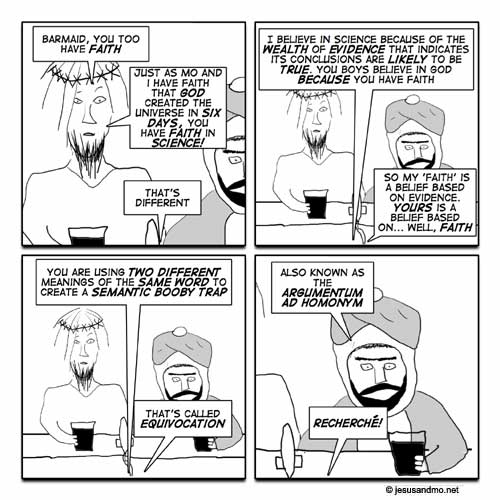
When Faith Is Dogma

Image from: Jesus and Mo
~*~
~*~
Most Christians believe that Jesus was the Son of God and, therefore, divine; Muslims, however, believe that Jesus was not divine and that anyone who thinks otherwise will suffer the torments of hell (Koran 5:71-75; 19:30-38). This difference of opinion offers about as much room for compromise as a coin toss.

If there is common ground to be found through interfaith dialogue, it will only be found by people who are willing to keep their eyes averted from the chasm that divides their faith from all others. It is time we began to wonder whether such a strategy of politeness and denial will ever heal the divisions in our world.

True dialogue requires a willingness to have one’s beliefs about reality modified through conversation. Such an openness to criticism and inquiry is the very antithesis of dogmatism. It is worth observing that religion is the one area of our lives where faith in dogma -- that is, belief without sufficient evidence -- is considered a virtue. If such faith is a virtue, it is a virtue that is completely unknown to scientific discourse. Science is, in fact, the one domain in which a person can win considerable prestige for proving himself wrong. In science, honesty is all. In religion, faith is all. This is about as invidious as comparisons get.

Whenever human beings make an honest effort to get at the truth, they reliably transcend the accidents of their birth and upbringing. It would, of course, be absurd to speak of “Christian physics” or “Muslim algebra.” And there is no such thing as Iraqi or Japanese -- as distinct from American -- science. Reasonable people really do have a monopoly on the truth. And while they might not agree about everything in the near term, common ground surrounds them on all sides. Consequently, there is no significant impediments within scientific discourse: It isn’t always pretty, but the conversation continues without appeals to force or deference to dogma. There are scientific dogmas, of course, but wherever they are found, they are set upon with hammer blows. In science, it is a cardinal sin to pretend to know something that you do not know. Such pretense is the very essence of religious faith.

It is not an accident that scientific discourse has produced an extraordinary convergence of opinion and remarkable results. What has interfaith dialogue produced? Meetings between representatives of the world’s major religions yield little more than platitudinous calls for peace and a willingness to ignore what many participants strongly believe -- that every other party to the conversation will probably spend eternity in hell for his misconceptions about God. The differences between scientific and religious discourse should tell us something about where to place our hopes for an undivided world.
~*~
Dictionary Definitions
~*~
"Religious faith represents so uncompromising a misuse of the power of our minds that it forms a kind of perverse, cultural singularity—a vanishing point beyond which rational discourse proves impossible." - Sam Harris


, , , , , ,

Link

Monday, December 18, 2006

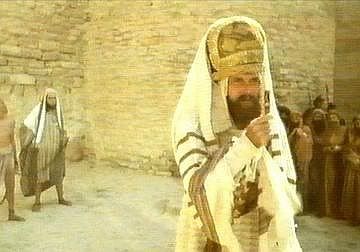
"Everybody Must Get Stoned"

Photobucket - Video and Image Hosting

"No one is to stone anyone until I blow this whistle" - From 'The Life of Brian'


"Well, they'll stone ya when you're trying to be so good,
They'll stone ya just a-like they said they would.
They'll stone ya when you're tryin' to go home.
Then they'll stone ya when you're there all alone.
But I would not feel so all alone,
Everybody must get stoned."


Many christians believe that the bible is the inerrant word and will of god. So what does the bible as the word of god have to say about evil? And what is the punishment for evil according to the will of god?

Firstly, the bible says that it is evil to speak of other gods as this is preaching rebellion against the one "true god" and that this evil must be purged. Now, I don't know about you, but purging doesn't sound too pleasant nor too friendly. Seems to kind of contradict that "love your neighbour as yourself routine." (Unless your neighbour likes a good purging, I guess.) It seems to me that purge used in this context means to put to death or otherwise eliminate (undesirable or unwanted members) from a political organization, government, nation, etc.

Deuteronomy 13:5
" That prophet or dreamer must be put to death, because he preached rebellion against the LORD your God, who brought you out of Egypt and redeemed you from the land of slavery; he has tried to turn you from the way the LORD your God commanded you to follow. You must purge the evil from among you. "

Ok, so christians are encouraged to purge from their midst, an old fashioned way of saying - "kill them", people who speak of other gods to christians. Right off the bat, it seems that religious tolerance might be a bit of a stretch. And what is the recommended method to purge evil according to the bible? You guessed it. A good old stoning is called for. Not the kind of stoning that involves a few buds and a pipe on the back verandah whilst listening to JJ Cale. No, this is a more permanent kind of stoning. The one that involves smallish rocks pelted at the person until they are dead.

So, you are compelled to put people to death who speak or preach about other gods, even if they are your brother, your son, your daughter or your wife. You are to stone them to death to remove the "evil" from your midst. Nothing like a good old-fashioned stoning to get the juices going. Perhaps this could be organized as a pre-sunday church service, to get the believers in the mood for total compliance.

Deuteronomy 13:6-11
"If your very own brother, or your son or daughter, or the wife you love, or your closest friend secretly entices you, saying, "Let us go and worship other gods" (gods that neither you nor your fathers have known, 7 gods of the peoples around you, whether near or far, from one end of the land to the other), 8 do not yield to him or listen to him. Show him no pity. Do not spare him or shield him. 9 You must certainly put him to death. Your hand must be the first in putting him to death, and then the hands of all the people. 10 Stone him to death, because he tried to turn you away from the LORD your God, who brought you out of Egypt, out of the land of slavery. 11 Then all Israel will hear and be afraid, and no one among you will do such an evil thing again."

I can hear some christians now jumping to the defence of what is left of their senses and saying, "but that is in the old testament, the new testament is what I follow." Take out the old testament and there is no god the father, god the sun, (oops sorry typo), and god the holy spirit; there is just jesus as god. This kind of defeats the purpose of jesus as god being born as a man to save humans from sins, if they wouldn't have committed these sins in the first place without the old testament.

What's next? Deuteronomy is full of examples of evil. It is literally the encyclopedia of what god considers evil acts. Let's see. If a girl is married and it can be proven that she was not a virgin on her wedding night, yes, you got it, a good old-fashioned stoning is called for.

Deuteronomy 22:20-21
"If, however, the charge is true and no proof of the girl's virginity can be found, she shall be brought to the door of her father's house and there the men of her town shall stone her to death. She has done a disgraceful thing in Israel by being promiscuous while still in her father's house. You must purge the evil from among you."

There doesn't seem to be the same punishment for men who are not virgins on their wedding night. That might be because they were too busy trying to entice the virgins in the town to have sex with them, so at a later date when they were married, they could stone them to death then. I don't know, just a guess. No TV, so they had to find entertainment in other ways. Nothing like a good stoning to build group cohesion.

Deuteronomy is just a cesspit of evil doings. Evil is mentioned everywhere and the punishment is the obvious. Whoever is being naughty needs to be pelted with rocks until they are dead. I wonder if there was a job for rock collecting?
"David and Sons Rock Collectors for Ritual Stonings - We supply the rocks, you supply the muscle. Bloodied rocks from previous stonings an added extra."
~*~
LINK: -

The Stoning Scene from Monty Python's "The Life of Brian."

, , , , , , , ,

Link

What Is Written On Page 123?

Image : - "The Golden Treasury of Verse" - Palgrave
~*~
I have been meme tagged by Silly Humans
~*~
  • The rules:-
  • Find the nearest book.-
  • Name the book and the author.-
  • Turn to page 123.-
  • Go to the fifth sentence on the page.-
  • Copy out the next three sentences and post to your blog.-
  • Tag three more folks.
Ok, the book is "The Golden Treasury of the Best Songs and Lyrical Poems in the English Language" selected and arranged by Francis Turner Palgrave.
~*~
Page 123 has the second half of "Willy Drowned In Yarrow" by anonymous.
~*~
The fifth sentence is: -
~*~
'O came ye by you water-side?'
~*~
and the rest of the verse is -
~*~
'Po'd you the rose or the lily?
Or came you by yon meadow green,
Or saw you my sweet Willie?'
~*~
(and get your minds out of the gutter as Willie is the child's name. Tsk Tsk.. )
~*~
The complete poem for anyone who might be remotely interested is here.
Now I will tag anyone who would like to continue this meme. A link back to me, of course, will always be appreciated but not compulsory. :)


, , , , , ,

Link

Saturday, December 16, 2006

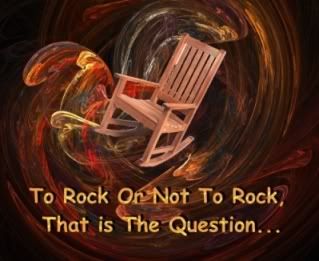
To Rock Or Not To Rock: That Is The Question...

Photobucket - Video and Image Hosting


The Case Of The Mysterious Rocking Chair From: A Conversation @ Philaletheia
~*~
My mother and I were sitting in the lounge of her house a number of years ago just chatting and watching TV when we heard a sound emmanating from the front verandah. Needless to say, this was quite late at night, most of the people in our street has gone to bed, not many lights were on, only a dim street light shone opposite us.
~*~
My mother, a delightful person that she was, was also highly imaginative and superstitious. I saw her eyes widen as we both listened to the sound, a steady “creak creak” on the 100 year old floorboards on the verandah. I watched and listened as I saw the physical reaction in my mother’s face and her body language. The primitive response to the unknown was about to receive full expression.
~*~
Needless to say, I felt and reacted to what I saw as her reactions as well. It was as if her anxiety was emotionally telegraphed to my synapses as well. Rather than be part of an irrational stampede to the upstairs bedroom where we might have locked the doors and waited in fear and forboding for whatever had made the mysterious noise, I decided to investigate for the sake of sanity and reason.
~*~
My mother, also quelled her desire for flight when she saw that I was prepared to confront whatever it was that was making this mysterious noise. I need to add at this time that my mother’s brother had died a few months ago, and so I had a pretty good idea where her brain was flying off to when it came to explaining the noise.
~*~
I opened the large timber door, with my mother peering over my right shoulder getting ready to scarper if anything threatening or frightening presented itself. We peered out into the murky darkness of the front verandah, listening intently as we tried to ascerain the specific location of the sound. And then we saw it. The large, old, rocking chair at the end of the verandah, bathed in soft moonlight, rocking steadily backwards and forwards.
~*~
By this stage of the proceedings, I am almost sure that my mother was “seeing” her recently deceased brother rocking backwards and forwards on that chair. Something he had done in the past. The sense of panic had escalated in both of us as we had determined the source of the sound, but not the cause of it. ( I think my mother had already settled on a cause by this time.)My mother was quite willing to accept that the cause was a spiritual one, I was less than convinced. (This all happened in a short time frame, just a matter of seconds.)
~*~
I flicked on the outside light. The rocking chair was still rocking, but it was slowing down now. Had our presence disturbed whatever was sitting in the chair and it had now left? No. On closer inspection there was my cat of 12 years sitting about 4 feet from the rocking chair staring at us in the bright light and surely wondering why we had these startled looks upon our faces.
~*~
The cat had slept on that rocking chair often and as it jumped off it in the darkness, the rocking chair did what rocking chairs do - they rock. Due to the recent circumstances of my uncle’s death, the darkness, the time of the evening (around midnight, if I remember correctly) and the human natural desire to attribute an explanation and a meaning for the unknown; our primitive instincts had kicked in.
~*~
Less rational heads would today be telling the story of how they had a visitation from a deceased member of their family and how they had NO rational explanation for why that chair was rocking in the moonlight. Primitive tribes may have made an altar to the chair and prayed for protection, good luck or fortune. People like my mother, saw it as a spiritual visitation from a dead relative. People like myself, look for a rational explanation first.
~*~
So what is it in us that allows us to make a variety of decisions based upon the same information? And why is it that we have a tendency to make hasty decisions based only tiny pieces of information?
~*~
Human beings are not so removed from their biological past. It is only in recent times, perhaps a few thousand years where the tables have changed and we are no longer being predated upon by a variety of dangerous animals. We are now the ultimate predators. We farm our prey and we farm them on a scale and diverse scale that could not be imagined by any other predator on this planet.
~*~
Instinctually, however, we are still wired for physical survival. Better to assume that some mysterious noise or shape is dangerous, suspicious, or a possible threat, than to stay and have possible harm inflicted upon the physical self. Obviously, humans, like other animals, don't want to be killed for some other animal's lunch. The gazelle which assumes that the small noise in the long grass is a threat, has a better chance of survival than the one who doesn't.
~*~
So why are these instinctual responses of fight or flight still so prevalent and obvious within the psyche of modern man? We have no real predators anymore, except for perhaps other humans who may wish to harm us, so why has this response remained so strong?
~*~
Firstly, this response may not been ameliorated by a large period of time. Secondly, it may not have been ameliorated by reason. In other words, our brains haven't caught up with the fact that the shape mysteriously lurking beside the tree is really the shadow of the house nextdoor, or that the eerie sound in the palm tree is a flying fox scavanging for fruit. We have continued to use the flight or fight response when trying to ascertain an explanation of the unknown, regardless of the truth of our assumptions.
~*~
When split second decisions are required, the response which is instinctually considered as preferable for survival is employed. That the assessment of the situation is wrong, was not seen as a necessary component for physical survival.
~*~
When confronted with a mysterious sound, event, shape, movement, the brain makes a split second decision along these lines. Friend or foe. It has been advantageous in our past to consider "foe" first. We are emotionally and psychologically culturally attached to some of these foes which we have created as explanations for the unknown. The desire to attribute a supernatural cause for a natural event is embedded deep within our psyche. Being intelligent animals with large brains, we have coalesced mysterious sights, sounds and actions into monsters of our own creation. Vampires, werewolves, succubi, demons, ghosts, devils, spirits etc all have at their root cause, the human need to explain what is considered an extraordinary or highly mysterious set of circumstances. The ability to feel fear has been a driving force towards survival and that we may have imaginatively created and perpetuated many of our fears, does not enter the realm of many people's consciousness.
~*~
It is why, under controlled conditions such as a movie, a ride at the theme park etc, we receive pleasure from a frightening situation. We literally confront these primitive fears and experience the rush of fright under controlled circumstances.
~*~
We remain the victims of our primitive fear response, though the need for this response has diminished. Many of us, are unwilling or unable to let go of that superstitious response to the unknown.
~*~
LINKS:
"While we continue to superstitiously create our castles in the air, we continue to add another brick to our earthly prisons." - me


, , , , , , , , , ,


John Williamson - "Home Among The Gum Trees"

Link

Thursday, December 14, 2006

Richard Dawkins - Speaks in Lynchberg Virginia


PART 1: Richard Dawkins reads excerpts from The God Delusion and answers questions at Randolph-Macon Woman's College in Lynchburg, Virginia on October 23, 2006. This Q&A features many questions from Jerry Falwell's Liberty "University" students.

PART 2: Richard Dawkins reads excerpts from The God Delusion and answers questions at Randolph-Macon Woman's College in Lynchburg, Virginia on October 23, 2006. This Q&A features many questions from Jerry Falwell's Liberty "University" students.

I found the second video where Professor Dawkins takes questions from the audience to be the most interesting. So, if you have time, watch at least the second video. You will be glad that you did.

LINKS:

RichardDawkins.net


"The meme for blind faith secures its own perpetuation by the simple unconscious expedient of discouraging rational inquiry." - Richard Dawkins

Link

Tuesday, December 12, 2006

Harry Potter Is Evil

TRANSCRIPT of another one of those whacky Jesus Camp Videos.

"And while I'm on the subject. Let me say something about Harry Potter. Warlocks are enemies of god. And I don't care what sort of hero they are they're an enemy of god and had it been in the Old Testament Harry Potter would have been put to death. You don't make heroes out of warlocks. This is a generation that is going to stand for purity and righteousness and holiness and you're going to serve the lord all the days of your life."


Is there anything funnier, sadder, and more disturbing than a middle aged obese woman preaching about the evils of a fictional character in a children's book? Probably, but this is disturbing to say the least. What part of "fictional character" for entertainment purposes doesn't she understand? All of it, it seems. She obviously have a great deal of difficulty in being able to stay in touch with reality, that is for sure.

She preaches as if warlocks are real. What a silly woman. There are, of course, people out there who believe in all sorts of insanities; who may also believe that they are warlocks. But generally these people are the same people who bare their buttocks at night hoping for a visitation from from an extra terrestrial who is doing research on the human race by sticking objects up their bums. Perhaps this also explains the high degree of correlation between the bible belt, republicanism, instances of alien anal probing and closet homosexuality. I wouldn't be surprised. Frankly, I am surprised that Ted Haggard hasn't resorted to this excuse by now. Maybe he suffered a particularly vivid alien anal probing, and has spent at least part of his time since attempting to repeat the experience with other humans. But I digress.

Anyway, back to the fat chick and her protestations that if Harry Potter had been in the Old Testament he would have been put to death. Fat, ugly chicks who wore black to try and disguise their 100 lbs of extra gluttony, would have probably been put to death in the bible as well. During any of the numerous invasions in the bible, she would have been superfluous to requirements and would not have been taken as war booty. I suspect she would have eaten the war booty. And if Harry Potter ever disappears msyteriously off the face of the earth, I will suggest that we pump the fat broad's stomach.

The danger of her rant though is perfectly clear. Is she assuming that young, impressionable children have the sophistication to be able to discern the difference between " if Harry Potter had been in the Old Testament he would have been put to death" and "Harry Potter should be put to death because the bible would do that." I doubt that their comprehension skills are that well honed. Obviously, I doubt her comprehension skills and grip on reality as well.

Children are, however, intellectually sophisticated enough to understand the differences between fiction and non-fiction if it is explained to them. And most children, even if they like the fantasy part of imagining magical powers, understand that that these stories are not meant to be real and are not to be considered as actual events.

Does she intellectually understand that Harry Potter is a work of fiction and if so, why does she rail against it with such animosity? I suspect that she may know what fiction is, she just doesn't approve of the competition. Afterall, while children and adults are enjoying the books of fiction involving Harry Potter, they are not paying enough attention to HER favourite book of fiction, the bible.

"Welcome! Welcome to the new year at Hogwarts! Before we begin our banquet, I would like to say a few words. And here they are: Nitwit! Blubber! Oddment! Tweak! Thank you!" - Albus Dumbledore

(I couldn't have said it better myself, Dumbledore.)

, , , , , , , , , ,

Link

Sunday, December 10, 2006

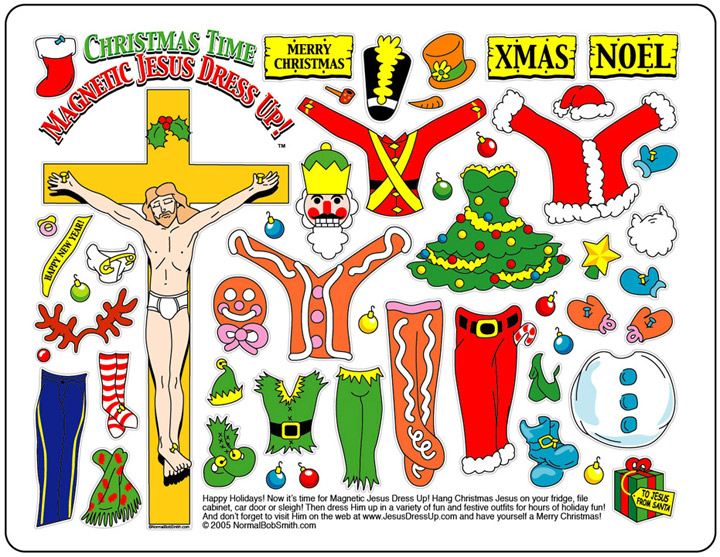
Now It's Time For Christmas Jesus Dress Up

~*~
Political correctness thy name isn't beepbeepitsme. Personally, my favourite outfit is the christmas tree dress coupled with rudolph's antlers. Any other suggestions?

Ten Seconds With Jesus

Jesus's Birth Date

, , , , , , , , ,

Link

Saturday, December 09, 2006

Male Brain - Female Brain

Click on image to enlarge it
~*~
I just did one of those tests that supposedly work out whether you have a male brain or a female brain. My inspiration to do such a thing was because I have heard many people state quite emphatically that men and women do NOT think the same way from a biological point of view. And that our differences have little to do with how we are raised and more to do with brain chemistry, but specifically the effects of male or female hormones upon the developing brain.
~*~
Somehow, this supposedly impacts upon neurological function which is then equated to the ability to perform certain mental tasks. Let me state from the outset that I am more than slightly skeptical. I know you are all shocked that I am skeptical of this, or anything else for that matter, as I am SO willing to accept whatever I am told at face value.
~*~
So, to cut a long story short, I did the test. And surprise, surprise, I have a "female brain." This could have something to do with the fact that I AM female, or it could have something to do with the test testing for that which it expects to be the results. I didn't see any science associated with this. By this I mean, how did they ascertain that it is the result of hormones which make the difference in the way a female or a brain works? Where is the scientific process that shows this?
~*~
For example: Many people will undoubtedly say that males have better spatial ability. As a general rule, I also consider this to be true. I certainly recognise that my spatial ability is rubbish and this was also evidenced by the test. But what sort of tests were undertaken as scientific process to show that it is the difference in male or female hormones which is the influencing factor?
~*~
I mean, did they conduct experiments with rats and ascertain that male rats on average find their way through a maze faster and with a greater degree of accuracy than female rats? Or did they assume that there ARE differences in how the brains of males and females work and then assume that these differences must be the result of hormonal differences?
~*~
I don't know. As I said, I haven't seen the science on this. But I do know that correlation doesn't equal causation. So, show me the science. How is environment, nurture, upbringing and experience factored out? Surely this is a variable that must be taken into consideration with human beings when attempting to ascertain differences in how the brain works? I have the suspicion that what they have tested is the result of environmental factors as much as anything else.
~*~
I suspect that this test has similarities to a survey done a couple of years ago by a specific banking institution. The banking institution in question had over a period of years removed many of its branches in towns and rural areas as a cost cutting measure. It then had installed automatic telling machines in many of these areas as substitution for the branches. A couple of years down the track, they conducted a survey which stated that people prefered to access automatic teller machines rather than to access a regional branch staffed by bank employees.
~*~
Of COURSE they prefered to access automatic teller machines. They prefered to have access to their money rather than NO access. What I am saying is - There was NO real choice. The survey was loaded towards the specifically desired conclusion. The survey was prejudicial towards people prefering ATM over branches. They did NOT factor into the survey the reality that an environmental factor played a part in their result. The environmental factor ignored was that the regional branches no longer existed.
~*~
I suspect that this test has similar flaws. Where large percentages of female children are still not encouraged to participate in games which build and develop spatial awareness, (that is, metaphorically bank branches that do not exist); how does this test or any other test be a realistic indicator of nature over nurture?
~*~

"He who joyfully marches to music in rank and file has already earned my contempt. He has been given a large brain by mistake, since for him the spinal cord would surely suffice." - Albert Einstein


David Gilmour and Roger Waters discuss the writing and recording of "Brain Damage" from Dark Side of the Moon.

~*~

Now on this test, which I also did for a bit of fun, the results are different. Should I be concerned that within a 2 day period my brain has transmogrified into a male one?

Your Brain is 33% Female, 67% Male

You have a total boy brain
Logical and detailed, you tend to look at the facts
And while your emotions do sway you sometimes...
You never like to get feelings too involved.


, , , , , , , , , , , ,

Link

Thursday, December 07, 2006

Stem Cell Research In Australia

A single cell is removed from a human embryo to be used to generate embryonic stem cells for scientific research.


Just a quick note for those of you who may have missed this. The Australian House Of Representatives has passed the bill to allow for the theraputic cloning of human embryos for medical research. Of course, the conservatives are all up in arms and I say "ner ner nerne ner" to them. The bill was approved by a vote of 82 to 62 in the House of Representatives, after being passed by the Senate last month. A poll published in June showed strong public support for stem cell research, with 80 percent public support for using cloning techniques to create embryonic stem cells.

LINKS:


Stem Cell Secret

, , , , , ,


Sam Harris on Stem Cell Research

Link

"Embrace Your Inner Fish"

Photobucket - Video and Image Hosting


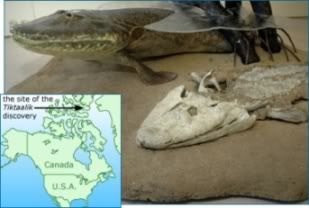
Image from: Understanding Evolution - A reconstruction of Tiktaalik alongside a cast of its fossil, and a map showing where the fossil was found, on Ellesmere Island, Nunavut, Canada.


Tiktaalik, of course. Pronounced tik-TAA-lik, this 375 million year old fossil splashed across headlines as soon as its discovery was announced in April of 2006. Unearthed in Arctic Canada by a team of researchers led by Neil Shubin, Edward Daeschler, and Farish Jenkins, Tiktaalik is technically a fish, complete with scales and gills — but it has the flattened head of a crocodile and unusual fins. Its fins have thin ray bones for paddling like most fishes', but they also have sturdy interior bones that would have allowed Tiktaalik to prop itself up in shallow water and use its limbs for support as most four-legged animals do. Those fins and a suite of other characteristics set Tiktaalik apart as something special; it has a combination of features that show the evolutionary transition between swimming fish and their descendents, the four-legged vertebrates — a clade which includes amphibians, dinosaurs, birds, mammals, and of course, humans.

Read more here.

LINKS:

Paleontologists at the University of Chicago have discovered a fossil fish that is transitional fossil between fish and land vertebrates.


University of Chicago fossil preparator, Tyler Keillor, discusses the iterative process of creating the model for Tiktaalik, the fossil discovery by paleontologist Neil Shubin that fills in the evolutionary gap between fish and land animals.


, , , , , , ,

“You ever noticed how people who believe in Creationism look really unevolved? You ever noticed that? Eyes real close together, eyebrow ridges, big furry hands and feet. "I believe God created me in one day" Yeah, looks like He rushed it.” - Bill Hicks

Link

Tuesday, December 05, 2006

You Are SO Damned!


Go on, you always wanted to do it and now is your chance:

Damn a soul at You are Damned .

Browse the list of the damned and their reason for being damned. Then, to damn a soul:

  • 1. Click on the “Damn a Soul” button
  • 2. Type the “Name of the Damned” (press enter)
  • 3. Type your name under ”Damned for” (press enter)
  • 4. Their email, your email and your name (press enter)
  • 5. Type their task for retribution under “To be saved the damned must” (press enter)
  • 6. Finally, click “DAMN THEM TO HELL”!


, , , , , ,


ACDC - Highway To Hell

,

Link

Sunday, December 03, 2006

Richard Dawkins - The Big Question: Why Are We Here?

Transcript of The Big Question: Why Are We Here?

The human race is one of the wonders of the universe. We may be unique. And of all our remarkable properties one stands out. It is that we are restlessly drawn to ask questions like: "Why are we here?" and "What is the purpose of life?"

The great civilizations and cultures of the past, came up with various answers, all unsatisfying because they were made up, rather than being properly investigated. So, can science come up with something better? I think so. It may sound presumptuous, but I believe that science CAN tell us why we are here. It can tell us the purpose of human existence.

The answer is an optimistic and an inspiring one. Why are we here? For most of the 500,000 years of human existence, we have been unable to answer the question of why we are here. It was only 150 years ago that science first tried to find an answer.

In 1859, Charles Darwin published a book which changed the world. When Darwin first got up the courage to publish the book, "Origin of Species", it shook the spiritual foundations of his age. Victorians had to come to grips with an entirely new set of unwelcome relations. We are over it now. Most of us are happy to teach our children that we are desccended from apes. We ARE apes. But I believe that Darwin has another message for us which could be frightening if we let ourselves be intimidated. But it's exciting and uplifting, if we have the courage to face it.

Not only did Darwin find the answer to the question of how did we come to exist, I believe his theory provides us with the answer we are probably only likely to get to the ultimate question - Why we exist - What is the purpose of life.

There are some 10 million species on earth. The displays here at the Natural History Museum at Oxford, represent only a tiny fraction of them. But before Darwin, no one knew how animals came to be so varied, so complex. Every last detail of every last creature's body and behaviour, seems exquisitely tailored to its environment. The platypus' webbed feet are built for efficient paddling and its duck bill is a radar electrically sensing its prey in the mud. As for the cheetah, its sleek and nimble body is a formidable machine for catching prey.

For centuries people tried to understand why animals were so perfectly equipped for their tasks. They assumed that there was only one explanation, the natural world was designed and that designer was god. The Reverand William Paley, writing half a century before Darwin, put the case with his famous "Watchmaker Argument."

Imagine, Paley said, taking a walk on the heath. If you came across a rock, you wouldn't be surprised. The rock could have lain there forever. It doesn't need explaining. But a watch on the heath would demand an explanation. It's existence and complexity would require a big explanation. The intricate precision of the cogs, the accuracy of which it keeps time, these are evidence that the watch must have had a designer. A watchmaker. Surely, Paley went on, no less is required to explain the even greater complexities of nature. There must be a divine watchmaker.

If I had read Paley in 1802, I might have agreed with him. But now things are very different. Charles Darwin has given us a much neater, more self-sufficient and therefore more satisfying explanation. Darwin argued that there was no designer. And at first sight this seemed like a ridiculous idea. Like Paley's watch, plants and animals appear to be staggeringly improbable combinations of their component parts all working towards one end. Take the nuts, cogs, bolts and springs of a watch and recombine them at random as many times as you like, only one arrangement tells the time. As the astronomer Fred Hoyle put it, the possibility that the parts of a living organism would spontaneously come together by sheer luck, is about as likely as a hurricane blowing through a scrap heap and spontaneously assembling a boeing 747.

So, how does nature do it? Even a fly is arguably more complex than a 747. If there is no designer, how did the complexity and variety of life come about? There's a clue as to how the process works in many people's back gardens.

There aren't many times when the pigeon has played a starring role in science, but it was this common place bird, that started Darwin on his journey of discovery. Darwin noticed that pigeon fanciers were able to breed new varieties. By carefully selecting mates, they had turned the ordinary pigeon into dozens of weird looking birds with weird sounding names. There were fantails, jacobins, short-faced tumblers and a horde of other varieties. Darwin knew that these all originated from one bird, the rock dove. And the pigeon breeder, Pat Pratt, can demonstrate that Darwin was right.

Pat Pratt - "If the fancy pigeons are allowed to breed as they like without any intervention at all from us, then at no time at all, they all revert to this wild type. Usually the first and second crosses from our fancy pigeons will show some type of return tothe drab blue colouring of the rock dove."

The effort to create different types is called artificial selection. And perhaps, Darwin reasoned, a similar process could occur in the wild. But how could selection occur in nature without a divine pigeon breeder to do the work?

The work of natural selection is classically illustrated by the finches that Darwin found on the Galapagos Islands. There are some 13 species all with different beaks. Yet, these varieties all evolved from one successful species which arrived from the mainland with one type of beak. One now behaves like a woodpecker, using a cactus spine to hunt for grubs. Another, now feeds on ticks living on giant tortoises while a third, the vampire finch, feeds on the blood of seabirds. These are all activities requiring different types of beak. Natural selection is about survival. The beaks changed, because the changes helped the finches to survive. And there wasn't a designer in sight.

When Darwin first explained evolution by natural selection, many people either couldn't, or wouldn't grasp it. I, myself, flatly refused to believe it when I first heard it as a child. For Darwin's theory to succeed, it had to explain both the wonderful variety of nature, and its astonishing conplexity. It does both with the utmost elegance.

My colleague, George Mc Gavin, has devised an experiment to show how natural selection works in practice. It explains how insects acquire their camoflage. They do it tiny bit by tiny bit.

George Mc Gavin - "What we have here is an artificial woodland floor on which I have placed a variety of insects. Some of the insects are very easy to see. Some of the insects are not so easy to see, and a few of them are extremely hard to see. Ok (to children), what we are going to pretend is that we are in a woodland and you are hungry birds out looking for insects. So, if you see something that you might want to eat. Say, I can see an insect. Who can see an insect? Me! Me! How many can you see? 3? 2? I can't see any.. "

The children play the role of predators. They show that even a little camoflage gives an insect some protection. So long as its predators don't get too close. If you are obvious, your chances of being eaten are really high. And therefore over time, small changes would make you not so obvious would be slected and passed on and so at the end of thousands of years of evolution, the end result will be an insect which is extremely well hidden in its background. The success of those hidden insects shows how natural selection rewards even tiny changes. The process of natural selection explains how simple structures over millions of years eventually evolved into complex, astonishing creatures, like the dinosaurs. Or us.

But natural selection is not some kind of awards ceremony, where nature applauds interesting new genetic mutations. It's not nature's fashion show. It's a competition to the death. Each individual within every species competes in the bloodthirsty and harsh real world for access to resources and for opportunities to reproduce. Natural selection is all about living long enough to pass on your genes.

Darwin realised that wild animals compete to survive and that more are born than the food supply can sustain. Inevitably, many die young, or they fail to reproduce. Amidst this wildspread slaughter, every animal fights a relentless battle for survival. In the natural struggle for existence, some variants were better at surviving than others. And they, passed their good qualities onto the future. Natural selection explains how we got to where we are now.

Does it also suggest to you a dark and troubling answer to the question - Why we are here? Natural selection suggests that we, like all other animals are survival machines. We are here only long enough to compete to pass on our genes. This seems to be the purpose of our lives and the reason we are here. But can this really be the only purpose of human existence? I don't think so. Darwin's remarkable theory offers a second meaning to our purpose. It's an inspiring one, which accords more fully with out own view of our better selves.

It stems from the curious observation that we humans seem to be breaking Darwin's rules. Human behaviour in the 21st century, seems to have nothing to do with what we call natural selection. Evolution may explain how humans came into the world, but it doesn't shed much light on the way we lead our lives today. Most of our energy goes into projects which seem to have nothing to do with the goals of survival or reproduction. We neither feel nor act as if we were driven by evolutionary complusion.

We seem to have freed ourselves from the need to spend all our time propogating our selfish genes. We have many other goals which take our time and energy. We explore the world around us. We create objects for their aesthetic beauty. We pursue hobbies for the sake of fun. And when we have sex, we defy our genes with contraception. If only they could think, our genes would be aghast at all this.

I, personally, am delighted that our big brains gave us the freedom to defy our selfish genes. The unrefined world of natural selection, is not the kind of world I want to live in. The beauty and purposeful elegance of cheetahs and gazelles is wrought at huge cost in the blood and suffering of countless ancestors on both sides. But IF the ultimate purpose of our existence is the narrow Darwinian one of propagating our genes, how can we defy them?

Ironically enough, the things that freed us from our genes, were also the result of natural selection. And it all began, millions of years ago, in Africa. At the time, humans were still prey. Surrounded by predators, we evolved survival tools. And the most important of these was the brain. Natural selection drove the development of the human brain. It did so with no more purpose than it drove the development of the tail of the peacock, or the speed of the cheetah.

The genetic advantage was rewarded and our brains got bigger. They didn't just be bigger, they became different. We evolved the ability to do something no other animal could do. Set goals. Find a new waterhole, plan a hunt, set aside food for the winter and we learn to adapt and change our thoughts. What natural selection built into us in Africa, was the capacity to seek, to strive, to set up short term goals in the service of long term goals and eventually, the capacity for foresight. Bigger brains allowed our individual ancestors to compete more effectively, and then, something unprescedented happened.

A brain arose that was able to look around the world, and ask, perhaps for the very first time, the question, WHY? Why are we here? We were no longer content to do what nature told us. We began to think about other goals that suited us. And we had a tool to express those goals - language. Speech let's us share goals. And a creature able to communicate its goals begins to think purposefully. Act purposefully. Create purposefully. And even more amazing, through language our goals can take on a purpose beyond the life of any one individual. One inventor can produce the wheel. Using language, generations of inventors share in the goal of fast cars and produce the modern one. Technology is human goal seeking writ large. And once human beings set themselves to a goal, they force the pace of evolution themselves.

This is an entirely new kind of evolution, non-genetic evolution. Advancing at the speed at maybe a million times faster than the genetic evolution which it resembles. We see its products everywhere in the technology of the modern world. We have created a technological world that enables us to move far beyond the dictates of nature. And it allows us to do astonishing things. We alleviate hunger with new strains of crops. Predict the weather with high speed computers and cure diseases with pharmecuticals. Through technology, we have filled the world with purposeful creations.

But technology does something else. It breeds an odd habit of thought. An animal who invents, will look at the world in a different way than any other animal. We see the world through "purpose coloured spectacles" . Because WE create things for a purpose, in the past we assumed that there was purposeful design in nature too. There wasn't as it happens. It took Darwin to realize this. He looked deep into the heart of nature and discovered a beautiful mechanism which blindly simulates the illusion of purpose. For the first time, an evolved creature had seen beneath nature's veil and worked out what nature was really up to.

And it is this spirit of enquiry that drove Darwin that gives our life meaning. It still drives us today. Powered by our technical capacity, our flexible behaviour and our rapid communication of new ideas; we've burst out beyong the confines of our atmosphere, to explore new worlds. And our minds have voyaged even further. We have looked across the deserted vacuum of space to the distant galaxies. Which means we have looked backwards in time, to the very birth of the universe and of time itself. At the other extreme, we have looked deep into the atom, at the strangeness of subatomic particles and most amazing of all, we have disected the living cell, finally unravelling the digital codes of the genes themselves. And still, we are not satisfied. We reach out in our search for meaning until we realize that it is we, who actually provide the purpose in a universe which otherwise would have none. Nothing else can do it. At least nothing we know of.

In a small, otherwise unimportant corner of the universe, a birth is celebrated. The birth of deliberate purpose. Planning, design, foresight. For all we know, it may be an unprecedented event. We have no evidence that it has ever occurred anywhere else, and after we are gone, it may never happen anywhere ever again. We can leave behind the ruthlessness, the waste, the callousness of natural selection. Our brains, our language, our technology, make us capable of forward planning. We can set up new purposes of our own. And among these new goals can be the complete understanding of the universe in which we live. A new kind of purpose is involved in the universe, it resides in us.

When I hear somebody sigh, "Life is hard," I am always tempted to ask, "Compared to what? - Sydney Harris

, , , , , , , , ,

Monty Python - The Meaning of Life - The Galaxy Song

Link

Saturday, December 02, 2006

The Answer Is X


"X Is The Answer" - A Conversation In Two Parts
~*~
The answer is X.
What do you mean the answer is X?
The answer is X.
But X doesn't mean anything..
Yes, it does, it means X.
Is X a letter?
No.
What does X stand for?
It stands for X.
Is it an animal, a mineral, a plant?
No, it is X.
Is it a process, a theory, a hypothesis, a conclusion?
No, it is just X.
You're being silly now.
X doesn't think so.
What do you mean X doesn't think so! You just said that X doesn't stand for anything, so how can it think anything?
Well, X just is.
X is just what? !
X just is.
Hmmmm. If X is the answer, what is the question?
If the answer is X, then the question should be X.
So if the question is X, the answer should be X?
Yes.
Why isn't Y the question?
If Y was the question, the answer should be Y.
Why can't Y be the question and X the answer?
Don't be silly. Then it wouldn't make sense.
It doesn't make sense already!
Yes, it does. Obviously Y is Y. It would be a pretty crazy world if X was Y and Y was X. Don't you think?
Ok. If X is just X, what is Y?
Y is Y.
Grrrrrr. What is X again?
X is X and if X is the question, the answer should be X.
So X is the question.?
If you say so...
What do you mean, if I say so? You just said that if X was the question then the answer should be X!
Yes. The answer should be X, but ONLY if the question was X. I didn't say the question WAS X.
So, the answer mightn't be X at all?
That's right. The answer depends on the question.
So, how do I know what the answer is?
The answer should be directly related to the question.
And the question will be directly related to the answer?
No.
But you just said that the question was X and the answer was X and that the question was Y, and the answer was Y.
Yes, I did.
So, if I know the answer is X, then the question must be X.
No.
No..??
No. Sometimes people supply the wrong answer to the right question.
So, the question is the most important thing?
Yes.
How will I know if I have the right question?
There are no right and wrong questions.
But you just said that the question is the most important thing!
Yes. The question is extremely important. Some people ask X and end up with the answer Y, or Z.
Don't tell me. If Y is the question, Y should be the answer. But if Y is the answer, the question might not be Y. And if Z is the question, Z should be the answer. But if Z is the answer, the question might not be Z?
By jove! You've got it!!
Got what?
X, of course...


~*~

As way of explanation: -

In "The Hitchhiker's Guide to the Galaxy" by Douglas Adams, there is a computer named 'Deep Thought' which was built by a race of super intelligent beings in order to calculate the answer to the ultimate question of life, the universe, and everything. When the answer is revealed as by 'Deep Thought' as 42, it evokes this reaction.

"Forty-two!" yelled Loonquawl. "Is that all you've got to show for seven and a half million years' work?" "I checked it very thoroughly," said the computer, "and that quite definitely is the answer.

I think the problem, to be quite honest with you, is that you've never actually known what the question is."

And so it is, most of us concern ourselves with the answer, whereas we should be spending more of our time on the question.

"The question you’re not supposed to ask is the important one." - Mason Cooley


The part in "Hitchhiker's Guide To The Galaxy" where 'Deep Thought' provides THE ANSWER.


, , , , , , ,

Link